Tuesday, March 13, 2012

So much talk about bugs that I caught one....

I've got nothing but a bit of a bug this week.  No, not an insect, but a slight fever and I've felt miserable.  I took three naps on Monday, and still had not a bit of trouble sleeping that night.  I'm better today, but I've still got nothing to write about.  If you want to see some cool pictures of our little Home Store, go to our Sunburst facebook page. 

One more thing, the weather is warm and beautiful, but apparently 6 or 7 weeks ago when the fruit was set, it's bound to have been a nasty, cloudy week because the picking is way off this week.  Have no fear, things will pick back up.  There's a nice fruit load up above this poor cluster and lots more to come.  The Old Greenhouse is about to start up!  Yes:)

Which one costs $700.00? 

You guessed it, and those bugs are fabulous!


Tuesday, March 6, 2012

No, We're not obsessed with bugs

When I think about the beneficial insects, I used to think of how the good bug must fly from the sky swooping down to snatch up its lunch, much like a bird of prey on a smaller bird.  Well, it's not quite that way with insects.

The heralded Aphidoletes aphidimyza is my new favorite aphid eater.  When Tim told me how these little fellows worked, I thought he was making it up. 

Aphidoletes aphidimyza is a tiny midge whose larvae are known to attack at least 60 different species of aphids.  Adults live an average of 10 days, and lay 70-100 eggs close to aphid colonies.  The eggs hatch after 3-4 days into orange, legless larvae that feed on aphids. 

HERE IS THE BEST PART.....THE LARVAE KILL APHIDS BY BITING THEM IN THEIR KNEE JOINTS, INJECTING A TOXIN THAT PARALYZES THEM, AND THEN SUCKING OUT THE BODY CONTENTS.    WOW!

The larvae can kill from 4-65 aphids in the 3-5 days they take to mature.  Then they spin cocoons and pupate for 2 weeks. 

We do not have an obsession with bugs, but they are a vital part of the health of our tomatoes.  If there was a better balance of beneficials insects to the bad insects, I wouldn't have much to write about, now would I?

Monday, March 5, 2012

Got to love those BUMBLEBEES!

Just like any other plant, greenhouse tomato plants require pollination to set fruit.   In the wild, this is done by bees, wasps, wind and other natural sources.   Some growers manually, or with a small “buzz” device, shake or vibrate the flowers or blossoms.   Rather than use manual devices, we use BUMBLEBEES from commercially produced beeshives that are designed exclusively for crop pollination.  We've been getting our bees from Koppert for 17 of the 18 years that we've been growing.  If you've ever pollinated tomato blossoms on 400 plants, for an entire season, with an electric toothbrush,  you'll find out why bees cost so much.  It's work!  The bees are worth every penny!  With the number of plants we have now, there's NO WAY we could do it manually.   Since a bumblebee only lives about 6 to 8 weeks, we continue to replace the hives throughout our growing season.

Most tomato growers are well aware of the efficiency of bumblebees for pollination.  Bumblebees are capable of ‘buzz pollination’.  The bumblebee places its upper body close to the pollen bearing structure of a flower, and vibrates its flight muscles. This vibration enables efficient pollination of tomatoes.  (More on the Buzz About Bees)

We receive our first hive of  bumblebees shortly after the first flowers appear.   Our greenhouse conditions seem to be perfect for supporting the hives.  In the wild, bumblebees don't work as well in the extreme high heat or in temperatures below 41 degrees.   But, in the winter months, we maintain an average temperature (trade secret) that is well within the comfort zone of our bumblebees.  With the bumblebees, the high and low temps may slow them down, but they do not stop working until day's end.

Quite often we are asked about our bees and as to why we don't use honeybees?  Have you ever been around a honeybee that didn't act a little pissed off angry?  Imagine yourself trying to work in an environment where a gang of bees were constantly daring you to get near the flowers they are about to have relations with?  All you'll want to do is get the heck out of there! 

Tim wanted to add this about honeybees......"Why wouldn't a worker bee be mad?  All they do is work themselves to death to support a queen who just sits around eating and laying eggs?  (By the way, Tim is not speaking from personal experience.  His wife is no queen bee!)  Let's stay on topic here.
The bumblebees are polite and go about their duties quietly and without an ounce of agression. They go about visiting the flowers one by one, then to the next plant, and so on. I call their method a "bee line". I'm sure that the term refers to something else, but that's my take on the bumblebee's work ethic.

Oh yes, they will sting you!   But, in the 17 seasons of  using bees, we've had less than 17 reported stings!   Yes, that's right, less than one a year.  Bumblebees are solitary bees are usually very docile, and stinging is rare.   Bees are not menaces, but they are is an extremely vital part of growing our food.    

THE WEEK IN REVIEW
This past week went pretty well. The daylight hours are increasing so the pounds per plant seem to be increasing as well. As usual we picked, packed, and delivered.   Jonathan and Daniel were sent to another location to continue the preparations for a later planting.  More pictures later!  We did the weekly plant maintenance in both houses; however, the tasks were not completed until today. (Monday)  It's already time to do it all over again for this week.


Hoping everyone has a sunny week! 


Saturday, February 25, 2012

Dream Job and Bad Bugs


Our son, Jonathan, is a 2004 graduate of NC State University and has worked in the so-called "real world" since that time. He has enjoyed jobs in Silver Spring, Maryland; then Cary, Raleigh, and Greensboro. He has been bossed around, and has been the boss.  His last job was such a nightmare that he doesn't even mind working for his work-aholic parents.

Not so much each individual task, but overall, Jonathan calls working here on our tomato farm his "DREAM JOB".  SWEET!!!! 

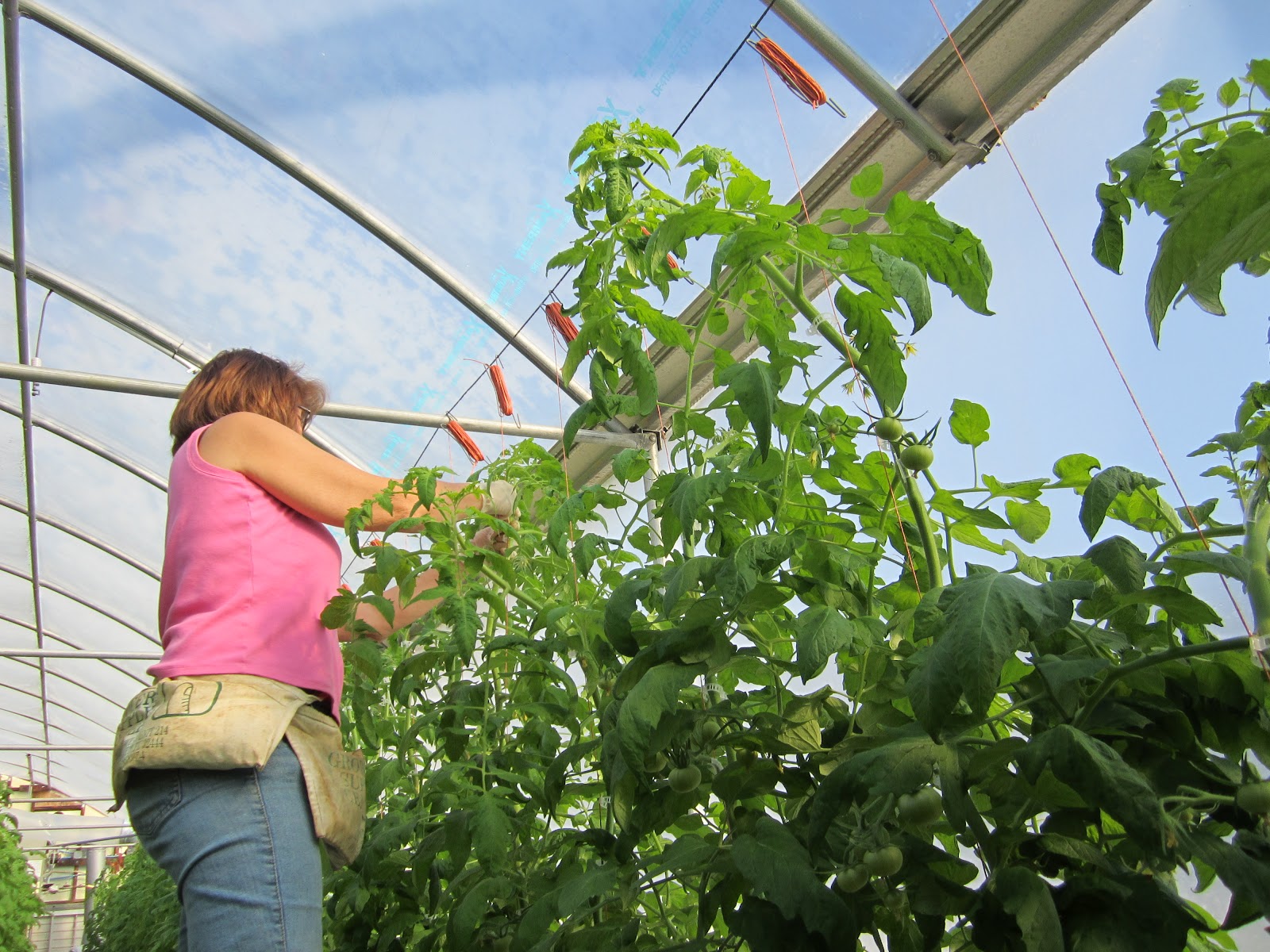
Being a little obsessive (like his mother),  Jonathan not only does the job at hand, but also grooms the plant of anything else that needs attention.   During the weekly leaf pull, we average pulling off 2 to 3 leaves per plant, per week.  This occurs at the bottom of the plant where the oldest leaves are. This time consuming job is not glamorous, but must be done for the overall health of the plant. We must be careful to break leaves off without breaking the plant and leave clean breaks so no disease will begin on the plant scar. 

While Jonathan is pulling leaves, he has started noticing tiny fruit that needs to be pruned off the plant, so he does that.  In addition, he notices plant scars that haven't healed properly, so he carries his trusty paring knife and scrapes the area clean.  He also sees plants that haven't slipped and broken (nearly half into without breaking completely) and repairs the damage with duct tape. (What else?)  He has an eye for details about the plant and will multi-task until he is satisfied with each plant's appearance and health.  That's a good thing unless you are dealing with 3,500 plants and must complete the leaf pull task by day's end.  (Thankfully we have Jeremy and Daniel pulling leaves with Jonathan and are able to finish one house in under a day.)

With all that observation and a "case of  tomato plant OCD", Jonathan has also found nasty little aphids!  He marks the spot where he has found them and Tim does his microscopic study of the little boogers and tells us that they are potato aphids.  Do those aphids not know that ours is a TOMATO, not potato, house?!?

Although we have already been putting our friends, "aphidius ervi", in the house, it seems that these GOOD bugs cannot keep up with the new outbreak of  BAD aphids.  The kind of aphid explosion we have witnessed this week was more and likely brought on by the lack of a good, cold winter.  Yes, we fight aphids, spider mites, and white flies every year, but this year, the aphids seem to be fighting back.  Since the really warm weather isn't even here yet, we have to step up our plan of attack.    We need more aphidius ervi to the tune of $700.00 this week.  Yes, $700.00 is an outrageous amount of money to spend on bugs that are practically invisible, but they are such a necessary part of our working paradise. 
Aphidius Ervi - aphid destroyer, magnified a jillion times
So we all continue to work and wage war against our enemies, the aphids, white flies, and spider mites.  Coming soon, a special treat the spider mite cannot resist.

Monday, February 20, 2012

"Smokeless Heat"

By beginning our tomato crop in October, you may wonder how we are able to heat the space (and I do mean space....12,000 plus square feet of area enclosed by a two thin layers of plastic).  We are burning woodchips in a “wood gasification boiler” which is also know as an "automated wood waste combustion unit".  

With mostly our own funds, and a little cost share assistance from Tobacco Communities Reinvestment Fund through RAFI we were able to purchase and put our boiler into operation in the 2010/2011 season.

Ours is a “Goliath 300” and was purchased from “New Horizons Corporation”.   The wood burns inside the firebox at approximately 2,000 degrees.   The woodchips are automatically fed into the firebox by a controller when heat is needed.  The Goliath unit will heat water to about 190 degrees.  This hot water is then pumped into the greenhouse into four 200,000 Btu heat exchangers.  The heat exchangers act similar to radiators by re-circulating the water from the boiler to the greenhouse.  Fans blow the greenhouse air across the hot coils inside the heat exchangers to extract the heat out of the water.  This system keeps the greenhouse space an average of 65 degrees. 

This one million Btu, woodchip burning boiler, with automatic feed, when combined with the proper water storage,  is capable of heating groups of houses, agricultural greenhouses, tobacco barns, chicken houses, workshops, etc.   For us, this heater is large enough for future greenhouse expansion.  For fuel, we are using ground-up wood waste (woodchips) from Elkin Sawmill, a central NC lumber yard.  The woodchips are a waste product from wood processing.

Research done by Dr. Mike Boyette of North Carolina State University has proven that this technology can heat greenhouses, chicken houses, and tobacco barns using woodchips. According to Dr. Boyette’s research, converting to wood boilers requires upfront capital costs, but this initial investment is quickly offset by the cost of wood energy.  Estimates are that the simple payback period of the wood boiler system is in the range of 4 to 5 years.  Our analysis reveals that we can recover the capital costs of converting to a wood energy system in about 3 years.  This is based on today’s price of woodchips relative to LP gas. 

I know this all sounds technical, scientific, and like way too much information, but our operation is now so much more cost effective by using wood waste instead of traditional fuel.   It's a great feeling not having to write out a check for LP gas at the end of the season.
FIRE! 
Not your typical flames, it's roaring sideways from the other box.  Within this box, the water in the pipe system is heated and then the heated water is pumped into the greenhouse heat exchangers.


Within 30 seconds of the picture of the fire, here's what the exhaust looks like.
That's how much smoke we get with a full burn. 
The boiler burns the wood and exhaust gases so HOT and thoroughly that we RARELY see smoke.


The clean, woodchip pile also serves as a great play area for our 3 yr. old grandson.


Thursday, February 9, 2012

A Tough Couple of Days

The week started out pretty nice with a good picking on Monday.  While our associates were picking, Tim decides to get on one of our working carts and begin working the tops.  (Clips, suckers, etc.)  I, Nancy, who is rarely pictured because I am the photographer, was on the other cart doing the same job.  In fact, that is my main job to go along with grading and packing of tomatoes for delivery. 


Not the large cart, I was on that one, but you get the picture.


A view from the top of the cart.  Note the narrow work space.  Falls sometimes occur.
When one set (two rows) is completed, those large, heavy carts need to be moved to the next set.  As Tim was moving the cart, he somehow had his RIGHT HAND in the wrong position and smashed the top of it pretty thoroughly.  He said he heard it go "crunch!!!"    There was a little blood and a bit of swelling. (Graphic)  He wrapped it in cloth and duct tape (what else) and came home so I could clean it and be grossed out.  I cannot stand the sight of spit, so how can I bear to look at blood.  (I know, much too graphic.)  After the discussion of how he should be more careful, we agreed that getting hurt with the work cart was just a fluke.  Heck we fall off all the time, but usually land on our feet.  After all, we've done this for 18 years.

The next day, Tim managed to smash his LEFT THUMB while using a hammer.  There was lots of throbbing going on, but nothing too gross. 
Within an hour of that, he went into an old shed looking for some type of wooden strips.  He hasn't been near that shed for ten years and just walks in like he had been there yesterday and steps on some hundred year old nail with his RIGHT FOOT.  The antique nail went through his boot, sock, and foot!  I can only imagine how he must have cried like a baby this time.

As he hobbled into the house, he said, "out of my four appendages, I only have one that ain't hurt, my left foot"!!!  (Tears)  Poor Tim.  I always almost afraid to look.  Nasty.  No other description is necessary.

This was late in the day so the tetanus shot was going to have to wait until the next day.  After a day of hobbling and moaning, he finally was able to see the doctor after 4:00 p.m.   While examining his foot, they saw his bandaged hand and asked what had happened.  Upon futher examination of the hand the nurse discovered the infection there. Not only did he get his tetanus shot, but a prescription to go with it. 

And to boot, while he was doing all that to get hurt, he missed a dental appointment.  He cannot tell the difference between Tuesday and Thursday.  Why can't this man just slow down and smell the tomato blossums?

Monday, February 6, 2012

 Being tomato growers, we learned quickly that on cold, cloudy, and rainy days, we do not "work the plants" for fear of breaks, leaf damage, and causing plant wounds that will not heal.  Overall, there are only a few tasks that we will do in the tomato houses on cloudy days. Once in awhile, when those nasty, raw days come around, we'll drive an hour and fifteen minutes east and have lunch at the Cypress Grill. 

Sometime around the second week of January, The Cypress Grill opens up for its short season. (Mid-January through early April)  What's the specialty.....fried (cremated) herring, an Eastern NC favorite. We try to go 2 to 3 times a year, and usually for lunch.

So far this year we've had with plenty of cloudy days, but we've not had the time to travel to Jamesville, NC....so when Saturday night rolled around, we needed to go out for a nice supper.  Yes, I'm an Eastern North Carolina southerner and will always call my evening meal supper.  Dinner is the big meal on Sunday after church, as well as all the big meals on my favorite holidays. 

Back to the Cypress Grill.   It's a wonderful place to be, with ambience like none other.  For goodness sake, it's a fish shack ON the Roanoke River that transports you back in time.  The owners are not even trying, it's just that quaint.   We love it!


My plate Saturday night.  Two herring, stewed potatoes,
 coleslaw, and hushpuppies.  All for only $7.95.
   All I added was the vinegar and salt on the herring.  Delicious!

So as not to disturb the other patrons, while we were there (the building is tiny), I only took pictures of my plate.  To get the full visual, go to the following blog.  You'll enjoy the experience.